Last updated: August 2026 | Data checked: August 2026
Both Microsoft Dynamics 365 and Salesforce were named Leaders in Gartner’s 2026 Magic Quadrant for CRM Sales Platforms, published August 6, 2026 – Microsoft for the sixteenth consecutive year, Salesforce for its own long-running streak in the category (Microsoft Dynamics 365 Blog; Salesforce). Neither is the “wrong” choice in the abstract. The right one depends on what your organization already runs, what it can afford, and which ecosystem your team already works in every day.
This comparison sets out the verifiable facts on cost, features, AI capabilities, and market position, then gives our own read on which kind of organization fits each platform.
Key Takeaways
- 01 – Both are Gartner Leaders. Microsoft and Salesforce were both named Leaders in the 2026 Gartner Magic Quadrant for CRM Sales Platforms; Oracle, a Leader in 2025, moved into the Challenger quadrant this year.
- 02 – Salesforce costs more at every comparable tier. Salesforce’s Enterprise tier lists at $175/user/month versus Dynamics 365 Enterprise at $105/user/month – a 67% premium at that comparison point, based on currently published list pricing.
- 03 – Salesforce remains the larger CRM vendor by market share. IDC estimates put Salesforce at roughly 20% of the global CRM market in 2025, the largest single share; Microsoft’s exact share is estimated but not officially disclosed.
- 04 – The AI platforms solve different problems. Microsoft Copilot Studio is built for broad agent creation across Microsoft 365 workflows; Salesforce Agentforce is built specifically for autonomous, CRM-native customer-facing agents inside the Salesforce data model.
- 05 – User ratings are close, but for different reasons. Both platforms sit at 4.4 stars on Capterra; Salesforce scores higher on functionality and breadth, Dynamics 365 scores marginally higher on value for money and customer service.
Quick Comparison Snapshot
| Metric | Dynamics 365 | Salesforce | Source |
|---|---|---|---|
| 2026 Gartner CRM Sales Platforms status | Leader (16th consecutive year) | Leader | Microsoft Dynamics 365 Blog; Salesforce, both Aug 2026 |
| Estimated global CRM market share (2025) | Not officially disclosed | ~20% | IDC-attributed estimate |
| Entry-tier price | $65/user/month (Sales Professional) | $25/user/month (Starter Suite) | Official Microsoft pricing; cross-verified Salesforce pricing |
| Capterra overall rating | 4.4 / 5 (5,846 reviews) | 4.4 / 5 (18,806 reviews) | Capterra, retrieved Aug 2026 |
| Native AI agent platform | Copilot Studio | Agentforce | Microsoft, Salesforce product pages |
Cost Comparison
Pricing is the clearest, most verifiable difference between the two platforms. Both vendors publish tiered, per-user, per-month pricing, billed annually.
Dynamics 365 Sales
| Tier | Price (per user/month, paid yearly) |
|---|---|
| Sales Professional | $65.00 |
| Sales Enterprise | $105.00 |
| Sales Premium (includes 1,000 Copilot Credits/user/month) | $150.00 |
Source: Microsoft’s official Dynamics 365 Sales pricing page, retrieved August 2026. Additional Copilot Credits beyond the included allotment are billed pay-as-you-go or through pre-purchased Commit Units.
Salesforce Sales Cloud
| Tier | Price (per user/month, paid yearly unless noted) |
|---|---|
| Starter Suite (monthly billing available) | $25 |
| Pro Suite | $100 |
| Enterprise | $175 |
| Unlimited | $350 |
| Agentforce 1 Sales | $550 |
Source: cross-verified against multiple independent pricing trackers as of August 2026; Salesforce’s own pricing pages returned access errors during this research and could not be fetched directly. Confirm current figures with Salesforce before making a purchasing decision – list prices for both vendors change without much notice, and Salesforce raised most Enterprise and Unlimited pricing roughly 6% in August 2025.
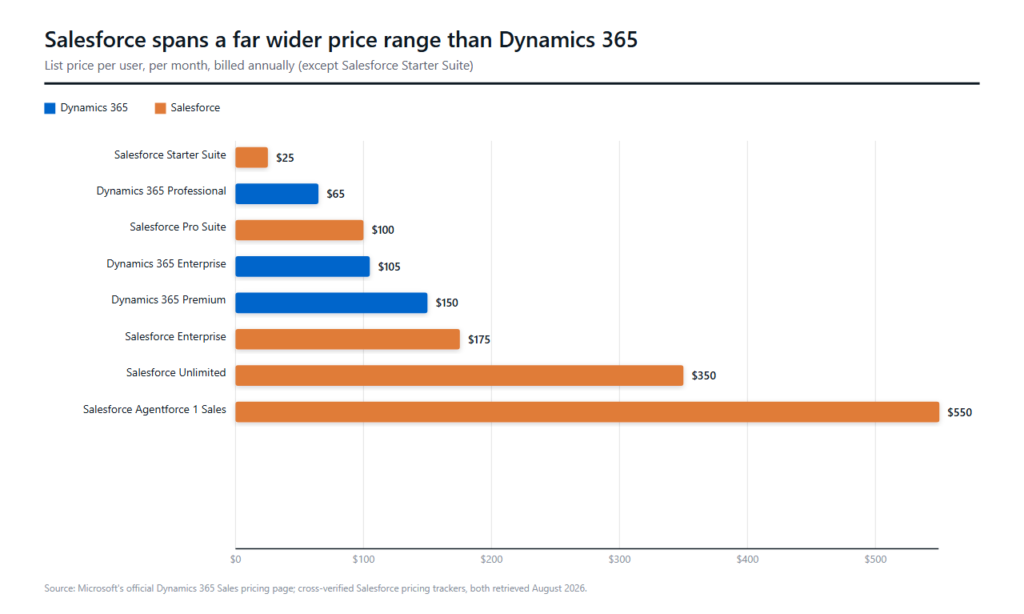
AqualityCRM analysis: At the entry tier, Salesforce is dramatically cheaper ($25 vs $65). But entry tiers rarely match feature parity – Dynamics 365 Sales Professional includes more built-in sales automation than Salesforce Starter Suite. The more useful comparison is at the middle tier most growing sales teams actually land on: Dynamics 365 Enterprise at $105/user/month versus Salesforce Enterprise at $175/user/month, a 67% premium for Salesforce at that comparison point. Whether that premium is worth it depends entirely on the feature and ecosystem sections below.
Feature Comparison
| Category | Dynamics 365 | Salesforce |
|---|---|---|
| Core CRM (contacts, leads, opportunities) | Full-featured across all paid tiers | Full-featured across all paid tiers |
| Sales automation | Built into Professional tier and above | Built into Starter Suite, deeper automation at Pro Suite and above |
| Customer service module | Separate Dynamics 365 Customer Service product | Separate Service Cloud product |
| Native AI agent platform | Copilot Studio | Agentforce |
| Reporting/analytics | Power BI integration (native, deep) | Native reporting; Tableau integration for advanced analytics (separate license) |
| Customization depth | Power Platform (Power Apps, Power Automate) | Native declarative tools plus Apex/Lightning for code-level customization |
| Ecosystem | Microsoft 365, Teams, Outlook, Azure | Salesforce AppExchange, MuleSoft, Slack |
| Administration | Power Platform admin center | Salesforce Setup |
Fact and analysis are kept separate deliberately here: the table above reflects what each vendor documents about its own product, not a ranking. Where a category requires judgment (which we flag clearly below), that’s our own read, not an industry consensus.
AI Capabilities: Copilot Studio vs. Agentforce
Microsoft describes Copilot Studio as “an end-to-end conversational AI platform that empowers you to create agents using natural language or a graphical interface,” built for three core functions: information retrieval and summarization, task automation, and increasingly autonomous multi-step work (Microsoft). It connects to more than 1,400 external connectors and publishes agents into Teams, SharePoint, and other Microsoft 365 apps, governed through the Power Platform admin center. It is not scoped specifically to CRM – it is a general-purpose agent-building platform that happens to include strong Dynamics 365 integration.
Salesforce Agentforce takes a narrower, more CRM-native approach: autonomous agents built directly on top of the Salesforce data model, using Salesforce’s Atlas Reasoning Engine, purpose-built for customer-facing workflows like case deflection, guided selling, and service automation within the Salesforce ecosystem specifically.
What this means practically: if the AI use case is “help our reps and service agents inside the CRM we already have,” Agentforce is more purpose-built out of the box. If the AI use case is “give our whole organization agents across email, Teams, documents, and CRM data,” Copilot Studio’s broader Microsoft 365 reach is the better architectural fit. Neither claim is a value judgment – they reflect two genuinely different product philosophies.
Ecosystem and Integration
This is where prior technology investment matters more than any feature checklist. An organization already standardized on Microsoft 365 – Outlook, Teams, SharePoint, Power BI – gets deep, largely pre-built integration by choosing Dynamics 365; Capterra reviewers specifically cite “the Microsoft ecosystem fit” as a reason they favor Dynamics 365, particularly when Outlook, Teams, Power BI, and customer data already sit inside the same operating environment.
Salesforce’s ecosystem strength runs through the AppExchange marketplace and its own acquisitions (Slack, MuleSoft, Tableau), giving it broad third-party app coverage and strong integration tooling independent of any particular productivity suite.
Neither ecosystem is objectively larger for every use case – they’re simply built around different centers of gravity: Microsoft’s around Microsoft 365, Salesforce’s around its own marketplace.
What Real Users Say
| Dynamics 365 | Salesforce Sales Cloud | |
|---|---|---|
| Capterra overall rating | 4.4 / 5 | 4.4 / 5 |
| Capterra review count | 5,846 | 18,806 |
| Value for money | 4.1 | 4.0 |
| Functionality | 4.3 | 4.4 |
| Ease of use | 4.1 | 4.0 |
| Customer service | 4.2 | 4.1 |
Source: Capterra, retrieved August 2026.
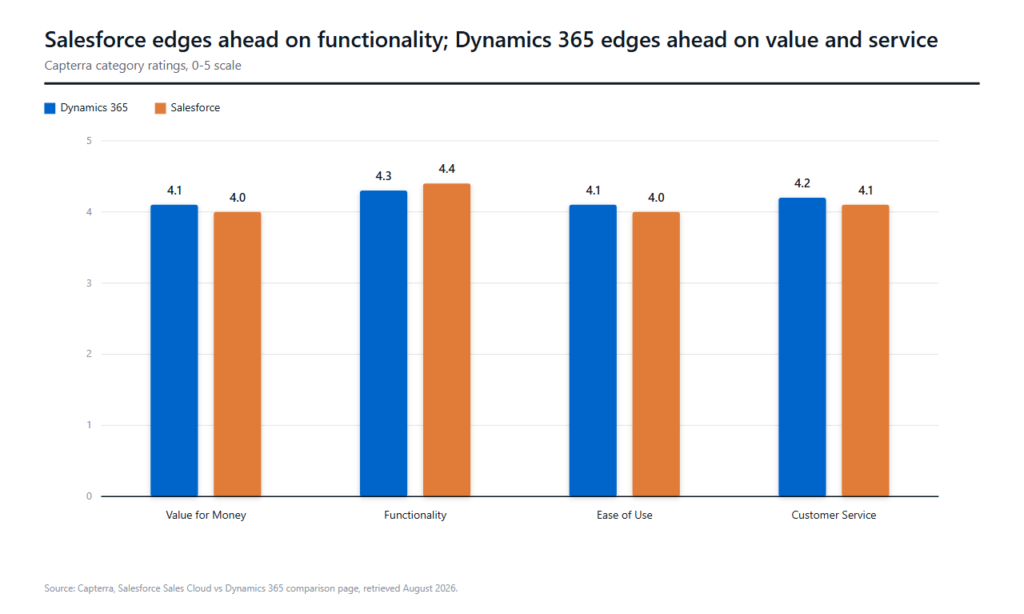
The two platforms land at an identical 4.4-star overall rating on Capterra, but the category breakdown tells the more useful story: Salesforce edges ahead on raw functionality, consistent with its larger, more mature marketplace and deeper out-of-box feature set at higher tiers. Dynamics 365 edges ahead on value for money and customer service, consistent with its lower price at comparable tiers and its Microsoft 365 integration reducing total tooling overhead for existing Microsoft shops.
What the ROI Studies Show (With a Caveat)
Both vendors commission their own Forrester Total Economic Impact (TEI) studies – a standard, disclosed industry practice, but one where the sponsor’s identity matters for how to weigh the result.
A Forrester TEI study commissioned by Microsoft found a projected 215% ROI over three years for Dynamics 365 Sales, with payback in seven months (Microsoft). Salesforce has commissioned comparable Forrester TEI studies for other products in its portfolio – 299% ROI for Marketing Cloud, 248% for Service Cloud – though we could not locate a Salesforce-commissioned Sales Cloud-specific TEI study directly comparable to Microsoft’s.
Read these figures for what they are: vendor-commissioned marketing research, conducted by a reputable independent firm using a disclosed methodology, but not neutral third-party benchmarking. Treat the specific percentages as illustrative of each vendor’s strongest possible case, not as a number your organization should expect to replicate.
Best-Fit and Poor-Fit Scenarios
Dynamics 365 tends to fit well when:
- The organization already runs Microsoft 365, Teams, and Outlook as its daily productivity stack
- Power BI is already the reporting standard
- The team wants deep customization through Power Platform without a separate developer-heavy stack
- Cost efficiency at the Enterprise tier matters more than the largest possible third-party app marketplace
Salesforce tends to fit well when:
- The organization needs the deepest, most mature CRM feature set regardless of cost
- Customer-facing AI agents built specifically for CRM workflows (Agentforce) are a near-term priority
- The team already relies on Salesforce-adjacent tools (Slack, MuleSoft, Tableau)
- Budget allows for a meaningfully higher per-user cost at comparable tiers
Neither is a strong fit when an organization hasn’t yet defined its core sales and service processes – both platforms are powerful enough to accommodate almost any process, which means an underdefined process gets automated badly regardless of which CRM carries it.
AqualityCRM Analysis
Our view, based on the data above and what we see across client engagements: organizations already standardized on Microsoft 365 should evaluate Dynamics 365 first, not because it’s cheaper (though at comparable tiers, it consistently is), but because the integration cost avoided – not having to bridge a separate CRM into an existing Microsoft-centric workflow – is often larger than the license price difference itself. Salesforce remains the stronger default for organizations with no existing platform allegiance and a genuine need for the broadest possible CRM feature set and third-party marketplace, and for teams whose AI priority is specifically CRM-native customer-facing automation via Agentforce today rather than broader Microsoft 365 agent coverage.
This is our interpretation of the data above, not an independently audited industry consensus – organizations should weigh it against their own specific requirements.
What Businesses Should Do
- Map your existing productivity stack before comparing CRM features. If your organization already runs Microsoft 365 fully, the integration savings from Dynamics 365 are usually larger than they first appear.
- Price at the tier you’ll actually need, not the entry tier. Entry-tier pricing headlines are misleading; compare Enterprise-to-Enterprise or Professional-to-Pro Suite, not Starter-to-Starter.
- Pilot the AI capability that matters most to you specifically, rather than treating Copilot Studio and Agentforce as interchangeable “AI features” – they solve different problems.
- Discount vendor-commissioned ROI studies to directional evidence, not a number to build a business case around directly.
- Get a demo scoped to your actual sales process, not a generic vendor walkthrough, before signing a multi-year contract at either vendor.
Frequently Asked Questions
Is Dynamics 365 cheaper than Salesforce?
At comparable Enterprise tiers, yes: Dynamics 365 Enterprise lists at $105/user/month versus Salesforce Enterprise at $175/user/month as of August 2026, based on Microsoft’s official pricing and cross-verified Salesforce pricing. At the very entry tier, Salesforce’s $25/user/month Starter Suite is cheaper than Dynamics 365’s $65/user/month Sales Professional, though the two entry tiers aren’t feature-equivalent.
Which CRM has better AI capabilities, Copilot or Agentforce?
They’re built for different jobs. Agentforce is purpose-built for autonomous, CRM-native customer-facing agents inside Salesforce. Copilot Studio is a broader agent-building platform spanning Microsoft 365, with strong but not exclusively CRM-focused capabilities. Neither is universally “better” – the fit depends on whether the priority is CRM-specific automation or organization-wide agent coverage.
Is Salesforce or Dynamics 365 the bigger CRM platform?
By market share, Salesforce is larger – IDC estimates put it at roughly 20% of the global CRM market in 2025, the largest single share of any vendor. Microsoft does not publicly disclose Dynamics 365 revenue separately, so its exact market share is estimated rather than confirmed.
Can Dynamics 365 or Salesforce integrate with Microsoft 365 and Google Workspace?
Dynamics 365 has native, deep integration with Microsoft 365 (Outlook, Teams, SharePoint, Power BI) by design. Salesforce integrates with both Microsoft 365 and Google Workspace through its own connectors and AppExchange listings, though the integration is not as deeply native as Dynamics 365’s relationship with Microsoft’s own productivity suite.
Methodology
This comparison combines Microsoft’s own published pricing (fetched directly from Microsoft’s official Dynamics 365 Sales pricing page), Capterra’s directly retrieved ratings and review data, Gartner Magic Quadrant status as reported by both vendors’ own official blogs, and IDC-attributed market share estimates. Salesforce’s official pricing pages returned access errors during this research; Salesforce pricing figures here are cross-verified against multiple independent, currently published pricing trackers rather than fetched directly from Salesforce, and should be confirmed with Salesforce before use in a purchasing decision. Forrester TEI ROI figures are vendor-commissioned studies, clearly labeled as such, and should be read as directional marketing research rather than neutral benchmarking. No figures in this article were estimated or calculated by AqualityCRM beyond the simple percentage-difference calculation in the cost comparison section, which is explicitly labeled as our own calculation.
Sources
- Microsoft named a Leader in the 2026 Gartner Magic Quadrant for CRM Sales Platforms for the sixteenth consecutive year, Microsoft Dynamics 365 Blog, published 2026-08-11, retrieved 2026-08-14
- 2026 Gartner Magic Quadrant for CRM Sales Platforms, Salesforce, retrieved 2026-08-14
- Dynamics 365 Sales pricing, Microsoft, retrieved 2026-08-14
- Salesforce Sales Cloud vs Dynamics 365: Features and Cost Comparison, Capterra, retrieved 2026-08-14
- Microsoft Copilot Studio product page, Microsoft, retrieved 2026-08-14
- The Total Economic Impact of Microsoft Dynamics 365 Sales, Forrester Consulting, commissioned by Microsoft, retrieved 2026-08-14
Evaluating Dynamics 365 for your business?
AqualityCRM can assess your existing environment, business processes, and integration requirements against both platforms and recommend an implementation approach that fits your organization – not a generic sales pitch.